
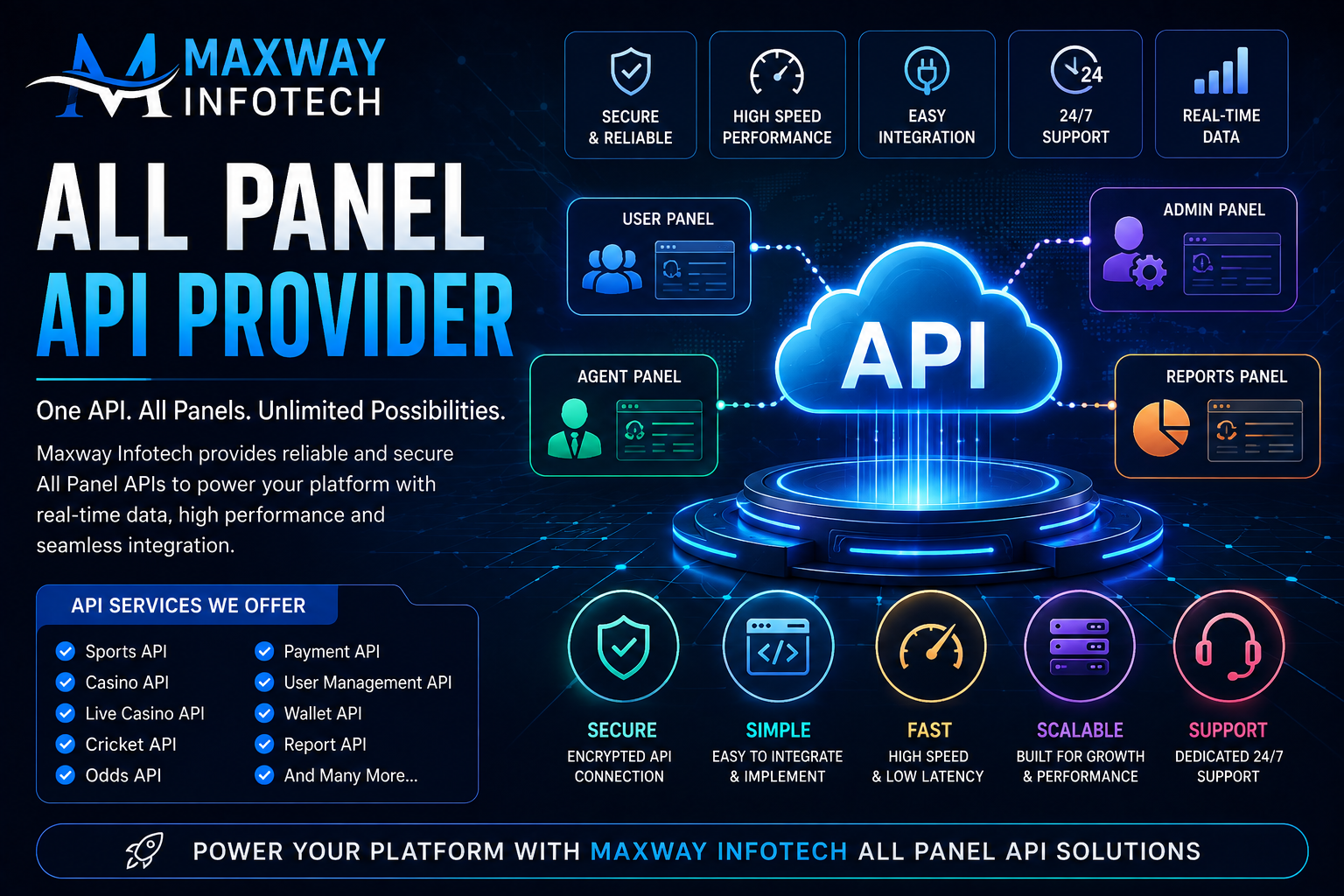
All Panel API Provider: Complete Guide to API Integration, Features & Benefits
Businesses operating complex digital platforms often need multiple services to work together through a single system. This is where an All Panel API Provider can play an important role. APIs allow different applications, dashboards, databases, and services to communicate with each other and exchange information efficiently.
An all panel API solution can connect different panels such as admin, master, agent, and user dashboards with the required backend services. Instead of managing every component separately, businesses can create a centralized technology ecosystem with structured API communication.
Maxway Infotech provides API and software development solutions designed around business requirements, with a technology stack that includes PHP, Node.js, React JS, MySQL, MongoDB, HTML5, CSS3, and Bootstrap.
What Is an All Panel API Provider?
An All Panel API Provider is a technology provider that offers APIs and integration solutions for connecting multiple panels and services within a centralized platform.
Depending on the project, an API ecosystem can connect:
- Admin panels
- Master panels
- Agent panels
- User panels
- Reporting dashboards
- Payment systems
- Authentication systems
- Third-party applications
- Internal databases
- Business management systems
The exact API structure depends on the platform’s requirements, user roles, data flow, and integrations.
How Does an All Panel API Work?
An API acts as a communication layer between different software components.
For example, when a user performs an authorized action through a frontend panel, the application can send a request to the backend API. The API processes the request, communicates with the database or connected service, and returns an appropriate response.
A simplified API workflow is:
User Panel → API → Backend → Database/Service → API Response → User Panel
This architecture allows different panels to use centralized business logic and data services.
Key Features of an All Panel API Solution
1. Centralized API Architecture
A centralized API structure can allow multiple dashboards to communicate with the same backend services.
This can make application management more organized and reduce unnecessary duplication.
2. Multiple Panel Integration
An API can connect different authorized panels, including admin, master, agent, and user interfaces.
Each panel can receive only the data and functions permitted for its role.
3. Secure Authentication
API authentication is an important part of a professional integration.
Depending on the application, developers may use:
- API keys
- OAuth
- JWT authentication
- Access tokens
- Role-based authorization
The appropriate method depends on the application’s architecture and security requirements.
4. Real-Time Data Communication
Some applications require frequently updated information.
APIs can support efficient data exchange between the frontend and backend, while technologies such as WebSockets or server-sent events may be appropriate for applications that genuinely require real-time updates.
5. Transaction and Data Management
Where legally and technically appropriate, APIs can connect applications with transaction or account-management systems.
Sensitive operations should include proper authentication, validation, logging, authorization, and security controls.
6. Reporting API
A reporting API can provide authorized dashboards with structured data for:
- User reports
- Activity reports
- Transaction records
- Performance statistics
- Account information
- Date-based analysis
7. Scalable Architecture
A well-designed API should be capable of supporting increasing traffic and additional integrations.
Developers can use appropriate architecture, caching, database optimization, load balancing, and monitoring to improve scalability.
Benefits of Using an All Panel API Provider
Centralized Management
Multiple applications and dashboards can communicate with a common backend.
Faster Integration
A properly documented API can make it easier for developers to connect new applications and services.
Better Data Consistency
Centralized business logic can reduce inconsistencies caused by maintaining separate systems.
Improved Scalability
A properly designed API architecture can support additional users, panels, and integrations as the business grows.
Easier Maintenance
When business logic is centralized in the backend, updates can often be managed more efficiently.
Flexible Technology
APIs can allow different frontend applications to communicate with the same backend without requiring every component to use the same frontend technology.
Types of APIs Used in All Panel Platforms
REST API
REST APIs are widely used for communication between web applications and backend services. They commonly use HTTP methods such as GET, POST, PUT, PATCH, and DELETE.
GraphQL API
GraphQL allows clients to request specific data fields. It can be useful for applications where different dashboards need different data structures.
WebSocket
WebSocket technology can provide persistent, two-way communication and is useful for applications that require real-time updates.
Internal APIs
Internal APIs can connect different services within the same application infrastructure.
The right API architecture should be selected based on the project’s requirements rather than simply choosing a particular technology because it is popular.
Important API Security Practices
Security is one of the most important considerations when selecting an All Panel API Provider.
A professional API implementation should consider:
- HTTPS encryption
- Strong authentication
- Role-based authorization
- Input validation
- Rate limiting
- Secure token management
- API access controls
- Error handling
- Logging and monitoring
- Data validation
- Regular security updates
API credentials should never be exposed in frontend code or publicly accessible repositories.
API Documentation Is Important
Good API documentation makes integration easier for developers.
Documentation should ideally explain:
- API endpoints
- Request methods
- Parameters
- Authentication
- Request examples
- Response formats
- Error codes
- Rate limits
- Versioning
- Integration requirements
Well-documented APIs can reduce development time and make future maintenance easier.
API Integration for Different Panels
An all panel API system can be designed around different user roles.
Admin API
The admin API can provide authorized access to platform configuration, user management, reports, and system-level operations.
Master API
A master-level API can provide access to specific functions or accounts assigned to the master role.
Agent API
An agent API can support authorized account or operational functions.
User API
The user API can provide account-specific services and information.
The permissions of each API should be clearly separated to prevent unauthorized access.
Why Choose a Professional All Panel API Provider?
Developing APIs requires more than creating endpoints. The provider needs to understand database architecture, authentication, authorization, application security, performance, documentation, monitoring, and long-term maintenance.
A professional provider should be able to explain:
- API architecture
- Authentication method
- Security controls
- Integration process
- Database structure
- API documentation
- Error-handling strategy
- Scalability
- Monitoring
- Maintenance
- Technical support
Choosing a provider based only on the number of APIs offered may create problems later. Reliability, documentation, security, and technical support are equally important.
Technology Stack for All Panel API Development
Different projects require different technologies.
Common technologies can include:
Backend: PHP, Node.js, Laravel, Python, Java, or other suitable technologies.
Frontend: React JS, JavaScript, HTML5, CSS3, Bootstrap, and other frameworks.
Database: MySQL, MongoDB, PostgreSQL, or other suitable databases.
API formats: REST, GraphQL, WebSocket, and internal service APIs.
Maxway Infotech publicly lists technologies including PHP, Node JS, React JS, HTML5, CSS3, Bootstrap, MySQL, and MongoDB as part of its technology capabilities.
How to Choose the Best All Panel API Provider
Before selecting an API provider, consider the following factors.
1. Technical Experience
Check whether the provider has experience developing APIs and complex web applications.
2. API Documentation
Ask whether complete technical documentation is provided.
3. Security
Understand how authentication, authorization, encryption, rate limiting, and monitoring are handled.
4. Scalability
Ask whether the API infrastructure can support increased traffic and future integrations.
5. Reliability
API downtime can affect connected applications. Ask about monitoring, uptime practices, backups, and incident handling.
6. Support
Technical support is important when developers encounter integration or API errors.
7. Customization
A good provider should be able to adapt the API architecture to the actual requirements of the project.
Why Maxway Infotech for All Panel API Development?
Maxway Infotech provides web development and software solutions for businesses that require customized digital platforms.
Its publicly listed technology capabilities include PHP, Node JS, React JS, HTML5, CSS3, Bootstrap, MySQL, and MongoDB.
For businesses searching for an All Panel API Provider, Maxway Infotech can be considered for projects requiring customized API development, web application development, database integration, and panel-based solutions.
The right solution should always be designed according to the project’s technical requirements, applicable laws, security standards, and integration needs.
Frequently Asked Questions
What is an All Panel API Provider?
An All Panel API Provider develops or supplies APIs that allow different panels and applications to communicate with a centralized backend system.
What panels can an API connect?
Depending on the project, APIs can connect admin, master, agent, user, reporting, finance, and other authorized panels.
Is an All Panel API secure?
Security depends on implementation. Strong authentication, authorization, HTTPS, validation, rate limiting, monitoring, and secure credential management are important components of a secure API.
Can an All Panel API be customized?
Yes. APIs can be customized according to the required panels, workflows, databases, integrations, permissions, and business requirements.
Does an API provider provide documentation?
Professional API providers should provide clear documentation covering endpoints, authentication, parameters, responses, errors, and integration procedures.
How much does All Panel API development cost?
There is no fixed price. Cost depends on the number of APIs, integrations, authentication requirements, database architecture, security requirements, documentation, scalability, and development complexity.
Conclusion
An All Panel API Provider can help businesses build a connected technology ecosystem where multiple dashboards and services communicate through a centralized backend.
A successful API solution requires more than functional endpoints. Security, documentation, scalability, authentication, data validation, monitoring, and long-term maintenance should all be considered during development.
Businesses searching for an All Panel API Provider should compare technical expertise, security practices, API documentation, customization capabilities, scalability, reliability, and support before selecting a development partner.
Maxway Infotech offers customized web and software development solutions and can be considered for businesses looking for professional API development and all panel integration services.